


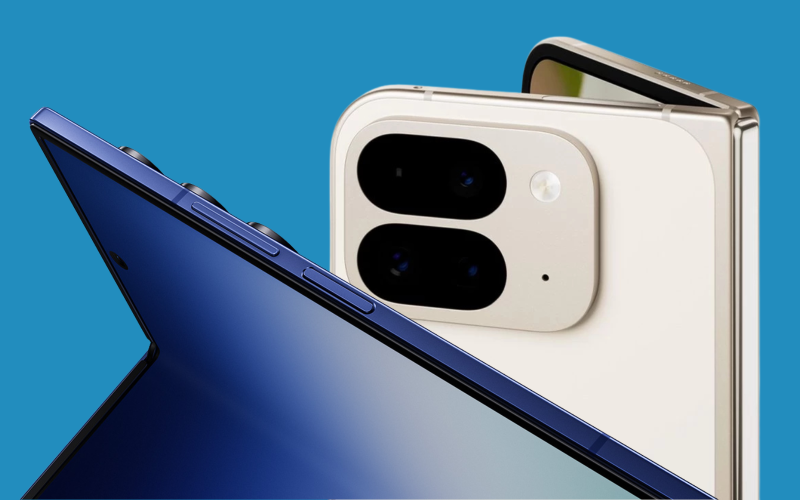
Foldable phones have been around for a few years now, but up until recently many compromises remained, fragility, uneven display quality, thick fold lines, short battery life. What we’re seeing now is manufacturers, especially Samsung and Google doubling-down on durability, better screens, more refined hardware and leaning into AI/software to make the foldable form actually useful rather than just a novelty.
Samsung’s 2025 foldable lineup builds on the Z-series, and the improvements are tangible.
Here are the main features and what they mean:
| Model | What’s New / Highlight Features | Pros & Considerations |
|---|---|---|
| Galaxy Z Fold7 | • 8-inch main display; larger, brighter, sharper. • 200MP wide-angle rear camera (a first in the Fold line) with advanced “ProVisual Engine” for camera/AI enhancements. • Slimmer, lighter body; improved hinge (“Armor FlexHinge”) with stronger materials (Armor Aluminum) and better glass (Ceramic / Victus) for durability. • IP48 rating for water/dust resistance (lesser than some “slopes,” but still a move forward) | Pros: Very strong imaging, better durability, more polished hardware. Cons: Prices are premium; foldables remain thicker/heavier than standard phones; IP48 isn’t as robust as IP68. Also, S-Pen not supported here. |
| Galaxy Z Flip7 | • Much larger outer (cover) screen (4.1-inch) so you can do more without unfolding. • Improved battery, better outdoor visibility (“Vision Booster”), more polished software integrations, improved brightness, etc. • More durable materials, better hinge etc. making fold/unfold feel more reliable. | Great for users who want compactness + novelty + a good selfie/cover screen experience. But it still can’t match a bar-style phone for certain tasks (typing, gaming, extended multitasking). Price remains high. |
| Galaxy Z Flip7 FE (Fan Edition) | • A more “affordable” flip foldable in Samsung’s premium lineup. • Some scaled-back specs: smaller outer screen, lower end chip (Exynos vs flagship silicon), lower RAM, etc. But keeps many of the design improvements. • Cheaper price point (still premium, but less than full flagship models). | Good option if you’re curious about foldables but not ready to spend flagship money. Compromises will show in performance and maybe in long-term durability. Also fewer color/finishes. |
Google has also made a strong push this year. Their foldable isn’t just “Pixel with a hinge” there are meaningful upgrades.
Key points:
| Strengths | What Might Be Less Ideal |
|---|---|
| Very competitive durability; IP68 is impressive. Big, bright displays and better hardware all around. Google’s AI/software is especially strong, adding value beyond the hardware. | As with all folding phones, cost is high. The weight and bulk when unfolded may still lag behind traditional phones. Battery size has limits (foldables consume more when displays are large); thermal management can be a concern. |
Putting the two side by side gives a clearer view of where things stand and what trade-offs to expect.
| Feature | Samsung Z Fold7 / Flip7 / Flip7 FE | Google Pixel 10 Pro Fold |
|---|---|---|
| Durability / Build | Very strong: new hinges, tougher materials, glass + metal upgrades, but only IP48 for Fold7. Lots of attention to lightness/slimness. | Top notch: IP68 water/dust resistance, gearless hinge, reinforced display. Strong contender for “most durable foldable.” |
| Displays | Large inner displays; big improvements in brightness, outer screen usefulness (especially with Flip7); Samsung’s display tech remains elite. | Also excellent displays, with high brightness, outer screen size increased, smaller bezels. Very competitive. |
| Camera & Imaging | 200MP camera in Fold7 is a headline spec; Samsung continues to push imaging with AI enhancements. | Very strong camera features; fewer megapixels than Samsung’s flagship in some instances, but Google’s image processing + software gives high quality. |
| AI / Software | Samsung is embedding more AI (Galaxy AI etc.), integrating with Google services, refining multitasking, DeX etc. | Google leans heavily into software; features like Gemini Live, Magic Cue, Instant View are strong differentiators. |
| Price & Value | Premium pricing, though the FE line helps a bit. More model choices across price segments. | Also premium, fewer model variants in the foldable line; you’re buying more into Google’s “ecosystem + software + durability” promise. |
If you’re considering a foldable now, here are some of the practical implications:
Even with all the improvements, foldables still face some inherent hurdles:
Looking ahead, here are things to watch:
If you’ve been curious about foldables, the current generation from both Samsung and Google marks a strong inflection point. The hardware is more mature, the durability is better and the software is catching up. If you rank a large display, with flexibility, or you often multitask, a foldable makes more now than ever.
However, if your priorities are ultra-light weight, lowest cost, or you want something rugged without trade-offs, a traditional smartphone might still serve you better.